













YouTube New Monetization Policy Update 2026: What Creators Need to Know
YouTube has announced one of its biggest changes to the YouTube Partner Program (YPP) since 2018, and creators who depend on YouTube income need to pay close attention.
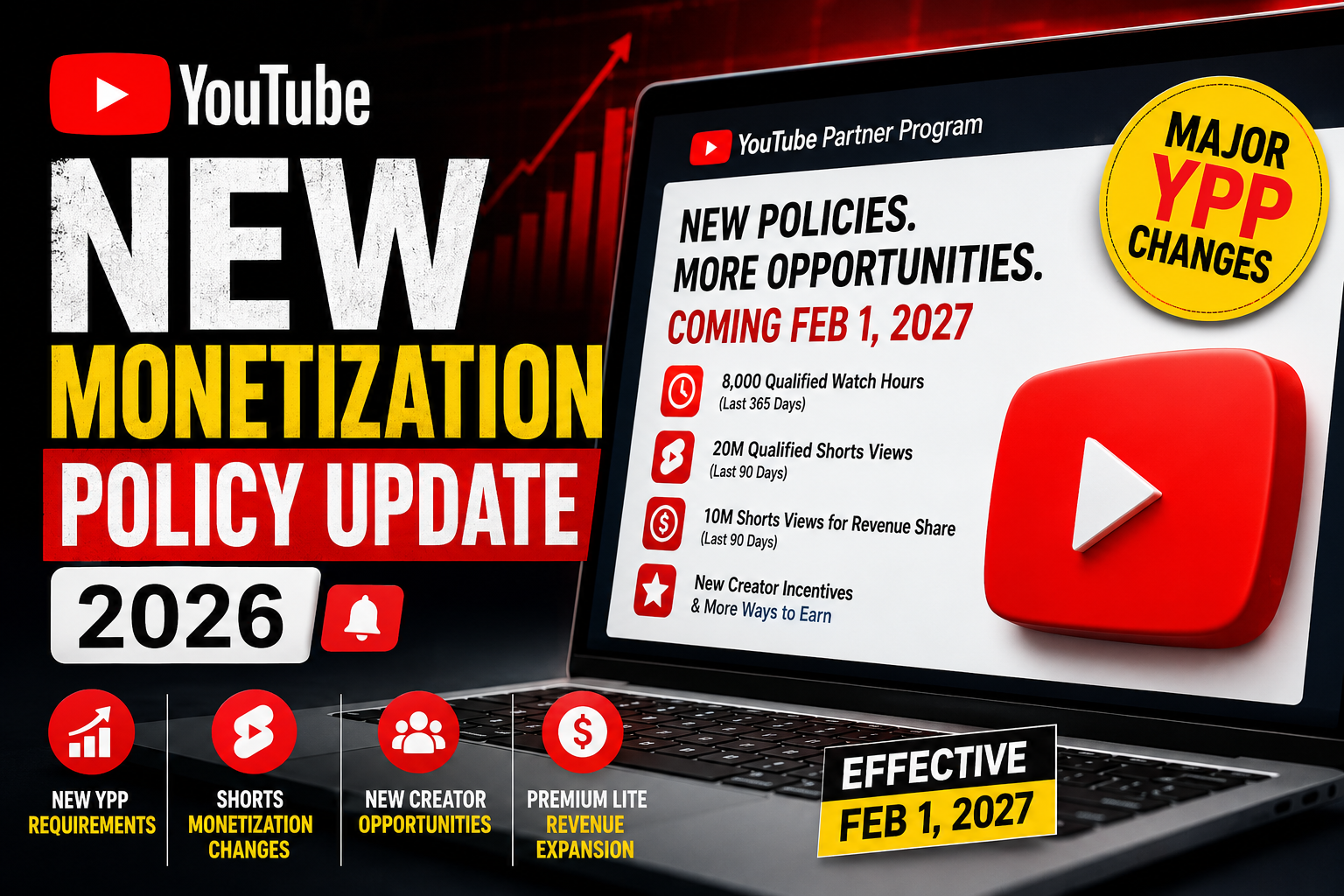
On August 10, 2026, YouTube announced major changes to its Partner Program, including new requirements for creators who want to earn advertising and Premium revenue, changes to Shorts monetization, expanded Premium Lite revenue opportunities, and new incentive programs for creators.
The changes are scheduled to take effect on February 1, 2027. YouTube says the goal is to better reward active creators and adapt monetization to the enormous growth of the platform. The company says more than 3 million creators are currently part of the YouTube Partner Program.
However, there is another important part of the YouTube monetization policy update that creators should understand. In July 2026, YouTube clarified its rules surrounding “inauthentic content,” including repetitive, template-based and mass-produced videos. This is especially relevant to creators using artificial intelligence to produce large quantities of videos.
So, what exactly is changing?
Let’s break down the latest YouTube monetization policy update.
What Is the New YouTube Monetization Policy Update?
The latest YouTube monetization changes are not simply about banning AI videos or removing existing creators from the YouTube Partner Program.
Instead, YouTube is changing how new creators qualify for certain types of revenue and is placing greater emphasis on consistent audience engagement, qualified views and active content creation.
According to YouTube’s official announcement, the new terms will take effect on February 1, 2027. Existing YPP creators will not be affected by the new entry thresholds for ads and Premium revenue sharing.
The major changes include:
- Higher YPP thresholds for new creators seeking advertising and Premium revenue.
- A new 10-million qualified Shorts views threshold for Shorts ad and subscription revenue sharing.
- Expansion of YouTube Premium Lite.
- New creator incentive programs.
- Continued enforcement against repetitive and mass-produced content.
- Increasing scrutiny of low-quality AI-generated and template-based videos.
YouTube Monetization Requirements Are Changing in 2027
One of the biggest parts of the new YouTube Partner Program update is the change to eligibility requirements for new creators.
Historically, one of the major full monetization routes required creators to reach:
- 1,000 subscribers
- 4,000 valid public watch hours during the previous 12 months
Alternatively, creators could qualify through Shorts with:
- 1,000 subscribers
- 10 million valid public Shorts views within 90 days
YouTube’s current documentation still reflects these established thresholds.
But starting February 1, 2027, YouTube says new creators applying for advertising and Premium revenue sharing will need:
Long-form route
8,000 qualified watch hours during the last 365 days
OR
Shorts route
20 million qualified Shorts views during the last 90 days
This represents a significant increase in the entry thresholds for new creators seeking ad and Premium revenue sharing.
Does This Affect Existing YouTube Creators?
According to YouTube, no.
The company specifically says that the new entry thresholds will not affect creators who are already in the YouTube Partner Program.
That means existing monetized creators do not suddenly have to reach 8,000 watch hours or 20 million Shorts views simply to remain in YPP under this particular change.
This distinction is extremely important because some social-media discussions have made the update sound like every monetized channel will immediately have to meet the new requirements.
That is not what YouTube’s official announcement says.
YouTube Shorts Monetization Is Also Changing
YouTube Shorts creators are another major group affected by the upcoming changes.
Beginning February 1, 2027, creators will need 10 million qualified Shorts views within the previous 90 days to be eligible for Shorts advertising and subscription revenue sharing.
Creators who fall below that threshold will remain in the YouTube Partner Program and can continue earning from long-form content.
If they later cross the 10-million qualified Shorts view threshold again, Shorts revenue sharing will automatically resume.
This is an important difference from saying that YouTube is completely removing Shorts monetization for smaller creators.
YouTube is not saying that smaller Shorts creators are automatically removed from YPP.
Instead, the company is changing access to Shorts ad and subscription revenue sharing while introducing other ways for smaller creators to earn.
Why Is YouTube Raising the Monetization Threshold?
YouTube says the creator ecosystem has grown dramatically.
The company says YouTube now sees more than 200 billion daily Shorts views and more than one billion hours of watch time on television every day.
With that enormous scale comes a major problem: there are huge numbers of creators producing content, and not all content provides the same level of value to viewers.
YouTube’s latest changes appear designed to place more emphasis on:
- Consistent audience engagement
- Qualified views
- Active creators
- Original content
- Long-term audience relationships
- Creator growth
- Meaningful participation in YouTube trends
Rather than relying entirely on advertising revenue, YouTube says it wants to introduce additional incentive programs.
These may include bonuses related to YouTube Shopping, incentives for brand deals and rewards for creators who start and grow trends. More details are expected from YouTube.
Is YouTube Banning AI-Generated Videos?
No.
This is one of the biggest misconceptions surrounding the latest YouTube monetization policy changes.
YouTube has not announced a blanket ban on AI-generated videos.
Instead, YouTube is increasingly targeting low-quality, repetitive, mass-produced and inauthentic content, regardless of whether AI was used to make it.
YouTube’s monetization policy states that repetitive or mass-produced material can be considered “inauthentic content” and may be ineligible for monetization. The company has also emphasized that the policy applies regardless of how the content was created.
That means using AI as a tool does not automatically make a video unmonetizable.
The bigger question is:
Does the content provide genuine original value to viewers?
For example, a creator could potentially use AI for:
- Brainstorming
- Research assistance
- Script development
- Editing
- Visual effects
- Voice processing
- Translation
- Animation
- Production assistance
But simply generating hundreds of nearly identical videos with minimal creative input is much more likely to create monetization problems.
YouTube’s 2026 Inauthentic Content Update Explained
In July 2026, YouTube further clarified its monetization rules around “inauthentic content.”
According to reporting from TechCrunch, the updated guidance identifies three broad categories of content that can create monetization problems:
1. Generic, Repetitive or Template-Based Content
This includes videos that are extremely similar from one upload to another and can be produced repeatedly with little meaningful variation.
A channel publishing hundreds of videos using essentially the same script, structure, visuals and narrative could therefore face problems.
YouTube has described the issue as “content farming” — creating large amounts of content primarily to generate revenue rather than providing meaningful viewer value.
2. Off-Putting or Emotionally Manipulative Content
YouTube is also taking action against content designed primarily to generate views by exploiting distressing or emotionally manipulative situations.
One example discussed by YouTube involved staged or manipulative videos featuring animals in distress followed by a supposed rescue.
The important point is that this restriction is not limited to AI-generated content. Channels built around this type of content can face monetization problems regardless of the production method.
3. AI Personas Discussing Sensitive Topics
Another area receiving attention is the use of AI-generated personas to discuss sensitive subjects.
YouTube has specifically highlighted areas such as:
- Health
- Medical information
- Finance
- Legal issues
Creators using synthetic personalities in these areas need to be especially careful about accuracy, authenticity and transparency.
Does Using AI Automatically Stop YouTube Monetization?
Again, no.
YouTube’s own AI disclosure policy provides an important distinction.
Creators are required to disclose realistic altered or synthetic content when appropriate. In May 2026, YouTube announced that it was also introducing additional internal signals to help identify AI-generated content automatically.
For photorealistic or meaningfully AI-altered content, YouTube has made labels more prominent. For long-form videos, the label can appear directly below the video player, while Shorts can display the label over the video.
However, YouTube explicitly says that an AI disclosure label by itself does not determine whether a video is recommended or whether it is eligible to earn money.
This means creators should not confuse:
AI disclosure
with
monetization violation.
They are separate issues.
The monetization problem is more closely connected to whether the content is original, valuable, repetitive, mass-produced or otherwise violates YouTube’s policies.
YouTube Premium Lite Is Expanding
Another major part of the latest YouTube Partner Program update involves Premium Lite.
YouTube says it is expanding Premium Lite to all countries where YouTube Premium is offered.
Premium Lite is a lower-cost subscription option that provides uninterrupted, offline and background viewing for most content.
YouTube says 60% of net Premium Lite subscription revenue goes into the dedicated creator revenue pool, compared with 30% for Premium subscriptions.
From the creator distribution, YouTube says creators receive a revenue share of:
- 55% for long-form videos
- 45% for Shorts
The distribution is based on member watch time and views.
This could become increasingly important as YouTube attempts to diversify creator income beyond traditional advertising.
What Should YouTube Creators Do Now?
If you already have a monetized channel, there is no reason to panic.
However, the latest YouTube monetization policy update is a strong signal about where the platform is heading.
Creators should focus on building channels around originality, audience value and sustainable engagement.
Here are some practical steps.
1. Stop Mass-Producing Nearly Identical Videos
If every upload looks like a slightly modified version of the previous upload, rethink the content strategy.
YouTube’s latest policy direction clearly favors meaningful variation and original value.
2. Use AI as a Production Tool, Not a Content Factory
AI can help creators work faster.
But avoid creating hundreds of videos where the only difference is the topic, title or a few words in the script.
Use AI to improve your creative process rather than replace it entirely.
3. Add Your Own Expertise
Your experience, opinions, analysis, demonstrations and storytelling can make content significantly more original.
For example, instead of asking AI to create a generic technology video, provide your own testing, screenshots, examples and conclusions.
4. Build a Recognizable Brand
A strong YouTube channel should have a recognizable personality.
This can come from:
- Your voice
- Your presentation style
- Your storytelling
- Your expertise
- Your visual identity
- Your opinions
- Your unique research
5. Don’t Chase Views With Manipulative Content
Short-term viral traffic may not be worth damaging the long-term reputation of your channel.
Focus on content viewers genuinely want to watch and return to.
What Happens to Faceless YouTube Channels?
The new policy does not mean faceless channels are automatically banned or demonetized.
A faceless channel can still produce original and valuable content.
For example, a faceless documentary channel could conduct original research, create unique scripts, use custom graphics, provide expert analysis and tell stories in its own distinctive way.
The problem arises when a channel becomes a content factory producing generic videos at scale with little meaningful differentiation.
Therefore, the real distinction is not necessarily:
Faceless vs. On-camera.
It is more accurately:
Original and valuable vs. repetitive and mass-produced.
This is an important distinction for anyone building a faceless YouTube channel in 2026 and beyond.
What the New YouTube Monetization Policy Means for Small Creators
The upcoming higher thresholds could make it harder for brand-new channels to reach full advertising and Premium revenue sharing.
For example, a new creator who previously aimed for 4,000 watch hours will now need to work toward 8,000 qualified watch hours under the new rules scheduled for February 2027.
Similarly, creators relying on Shorts will face a much higher threshold for Shorts revenue sharing.
However, YouTube says the lower thresholds for Fan Funding and shopping products remain unchanged, creating alternative monetization opportunities for creators who do not yet qualify for the higher ad-revenue thresholds.
This means creators should think beyond AdSense.
Other potential revenue streams include:
- YouTube Shopping
- Brand partnerships
- Sponsorships
- Channel memberships
- Super Thanks
- Super Chat
- Merchandise
- Affiliate marketing
- Digital products
- Courses and services
The strongest creators may increasingly build multiple income streams rather than depending entirely on YouTube advertising.
YouTube New Monetization Policy Update: Key Takeaways
Here is the most important information creators should remember:
| Update | What It Means |
|---|---|
| New YPP ad/Premium threshold | 8,000 qualified watch hours OR 20M qualified Shorts views for new applicants |
| Shorts revenue sharing | 10M qualified Shorts views in 90 days |
| Existing YPP creators | New entry thresholds do not affect existing YPP creators |
| AI videos | Not automatically banned |
| Mass-produced content | Can be considered inauthentic and ineligible for monetization |
| Repetitive videos | Increased scrutiny |
| AI personas | Extra caution for health, finance, legal and medical topics |
| Premium Lite | Expanding to countries where YouTube Premium is offered |
| New creator incentives | Shopping, brand deals and trend-related opportunities are planned |
| Effective date | February 1, 2027 |
The official YouTube announcement confirms that creators can review and sign the new YPP terms through YouTube Studio, with the new terms taking effect on February 1, 2027.
Final Thoughts: Is YouTube Becoming Harder to Monetize?
Yes — for new creators seeking advertising and Premium revenue, the upcoming requirements are significantly higher.
But the broader message from YouTube is not simply “make more videos.”
It is the opposite.
YouTube appears to be moving toward a creator economy where quality, engagement, originality and active participation matter more than simply uploading huge quantities of content.
The July 2026 inauthentic-content clarification reinforces this direction. YouTube wants to discourage content farming, repetitive videos and low-value AI-generated material while still allowing creators to use AI as a legitimate creative and production tool.
The August 2026 YPP announcement takes that strategy further by changing monetization thresholds for new creators, increasing the Shorts revenue-sharing threshold and introducing additional creator incentives.
For creators, the safest strategy is therefore straightforward:
Don’t build a channel around quantity alone. Build a channel around value.
Use AI when it makes you more efficient. Use automation when it improves your workflow. But make sure the final content has a clear reason for existing and gives viewers something they cannot get simply by watching hundreds of nearly identical videos.
The YouTube monetization landscape is changing, but creators who build original brands, develop loyal audiences and consistently deliver valuable content still have significant opportunities to grow and earn on the platform.
Sources: YouTube’s official Partner Program announcement and monetization documentation, plus current reporting from TechCrunch on the July 2026 inauthentic-content clarification.